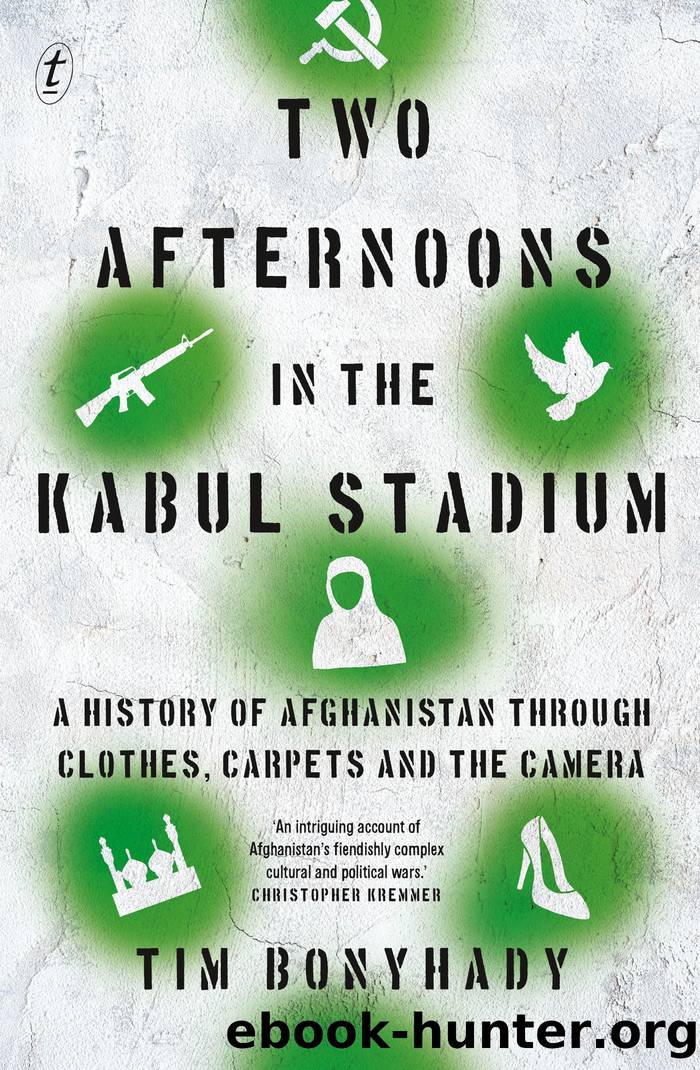
Two Afternoons in the Kabul Stadium: A History of Afghanistan Through Clothes, Carpets and the Camera by Tim Bonyhady
Author:Tim Bonyhady [Tim Bonyhady]
Language: eng
Format: epub
Tags: history, Asia, Central Asia, Social Science, Developing & Emerging Countries, sociology, General
ISBN: 9781922459169
Google: FOQnEAAAQBAJ
Publisher: Text Publishing
Published: 2021-08-03T23:22:14.135953+00:00
CHAPTER 18
Kalashnikov Culture
Bazaars have famously been settings for storytelling, sources of rumour and sites of political power, intrigue and dissent, as well as domains of trade. They have rarely been thought of as places where an artist might go to discover what is for sale and respond by innovating. Yet like art galleries and museums, bazaars have sometimes played this role, as happened in 1987 when Safer Ali, a Hazara rug maker, who had just fled to Iran from Herat, first visited Mashhadâs main carpet bazaar. When he saw a group of fellow refugees examining a rug, Safer Ali initially could not understand why these dealers paid it particular attention. Then he saw that, instead of conventional geometric, botanical or zoological patterns, guns and helicopters filled its central field.
This experience recurred time and again as people around the world saw war rugs for the first time. They would not realise they were looking at anything novel, then be amazed to discover they were. The question was: would they embrace or reject it? As Safer Ali watched the dealers in the Saâid Bazaar, he âhad the feeling that they were insecure, they didnât quite know what to makeâ of the guns and helicopters. Some found the rug âinteresting and admired itâ. Others were âless enthusiastic, even angry about the barefaced divergence of the motifsâ. Safer Ali, an experienced weaver of Turkmen rugs, was so excited that he decided to make war rugs too. While many other refugees in Pakistan and Iran simply replicated designs from Afghanistan, Safer Ali was among those who chose to develop new ones that tended to be clearly partisan, supporting the mujahideen.
We know of Safer Ali because of Masoud Farhatjar, who left Herat before the Saur Revolution to complete his schooling in Copenhagen, then moved to the German city of Freiburg im Breisgau where he attended university and became a rug dealer. When Farhatjar acquired his first war rugs, he showed them to Eva Gerharts, the director of Freiburgâs Ethnographic Museum, one of several such institutions in Germany to recognise the rugsâ significance while others in Germany, Switzerland and the Netherlands fixed on Afghan childrenâs art. Gerharts responded by becoming the first museum director to buy war rugs and, at Farhatjarâs suggestion, staged an exhibition in 1994, curated by German ethnologist Karin Knauer.
Farhatjar and Knauer were exceptional in interviewing weavers to discover their motivation and identifying war rugs, wherever possible, as the creations of named individuals rather than anonymous makers. On one of his regular trips to Iran, Farhatjar bought three of Safer Aliâs war rugs for the Freiburg museum, questioned him about his work and photographed him at his vertical loom. On another trip to Pakistan, Knauer interviewed women weavers and Farhatjar interviewed men.
By then, many war rugs were being made in response to market demand. Some weavers were copying designs not their own, unaware of their meaning. When interviewed by Knauer and Farhatjar, several weavers explained that they made war rugs because they sold better than traditional designs.
Download
This site does not store any files on its server. We only index and link to content provided by other sites. Please contact the content providers to delete copyright contents if any and email us, we'll remove relevant links or contents immediately.
Personalized inhaled bacteriophage therapy for treatment of multidrug-resistant Pseudomonas aeruginosa in cystic fibrosis by unknow(214297)
CONSORT 2025 statement: updated guideline for reporting randomized trials by unknow(102519)
Critical evaluation of the ProfiLER-02 study design and outcomes by Vivek Subbiah & Razelle Kurzrock(102042)
Cardiac gene therapy makes a comeback by Oliver J. Müller & Susanne Hille & Anca Kliesow Remes(101837)
Whisky: Malt Whiskies of Scotland (Collins Little Books) by dominic roskrow(74618)
Unveiling the design rules for tunable emission in graphene quantum dots: A high-throughput TDDFT and machine learning perspective by Şener Özönder & Mustafa Coşkun Özdemir & Caner Ünlü(51000)
A yeast-based oral therapeutic delivers immune checkpoint inhibitors to reduce intestinal tumor burden by unknow(40371)
Covalent hitchhikers guide proteins to the nucleus by Alexander F. Russell & Madeline F. Currie & Champak Chatterjee(40295)
Meet the Authors: Christopher R. Mansfield and Emily R. Derbyshire by Christopher R. Mansfield & Emily R. Derbyshire(40204)
Alkaline-earth metals promote propane dehydrogenation with carbon dioxide through geometric effects: Altering the reaction pathway by unknow(32813)
Induced iron vacancies boosting FeOOH loaded on sustainable Fenton-like collagen fiber membrane for efficient removal of emerging contaminants by unknow(32609)
Efficient electric-field-assisted photochemical conversion of methane to n-propanol exclusively over penetrated TiO2Ti hollow fibers by Guanghui Feng(32528)
Bi2SiO5 nanosheets as piezo-photocatalyst for efficient degradation of 2,4-Dichlorophenol by Hangyu Shi & Yifu Li & Lishan Zhang & Guoguan Liu & Qian Zhang & Xuan Ru & Shan Zhong(32465)
A novel NDIPTA organic heterojunction photocatalyst with built-in electric field for efficient hydrogen production by Jiahui Yang & Baojun Ma & Yongfa Zhu(32438)
Enhanced conversion of methane to liquid-phase oxygenates via hollow ferrite nanotube@horseradish peroxidase based photoenzymatic catalysis by Jun Duan & Shiying Fan & Xinyong Li & Shaomin Liu(32404)
Ordered macroporous superstructure of defective carbon adorned with tiny cobalt sulfide for selective electrocatalytic hydrogenation of cinnamaldehyde by Xiao-Shi Yuan & Sheng-Hua Zhou & San-Mei Wang & Wenbo Wei & Xiaofang Li & Xin-Tao Wu & Qi-Long Zhu(32333)
What's Done in Darkness by Kayla Perrin(27248)
Topological analysis of non-conjugated ethylene oxide cored dendrimers decorated with tetraphenylethylene: Insights from degree-based descriptors using the polynomial approach by A Theertha Nair & D Antony Xavier & Annmaria Baby & S Akhila(26628)
Investigation of mechanical and self-healing properties of hydroxyl-terminated polybutadiene functionalized with 2-ureido-4-pyrimidinone by Mohsen Kazazi & Mehran Hayaty & Ali Mousaviazar(26554)
